






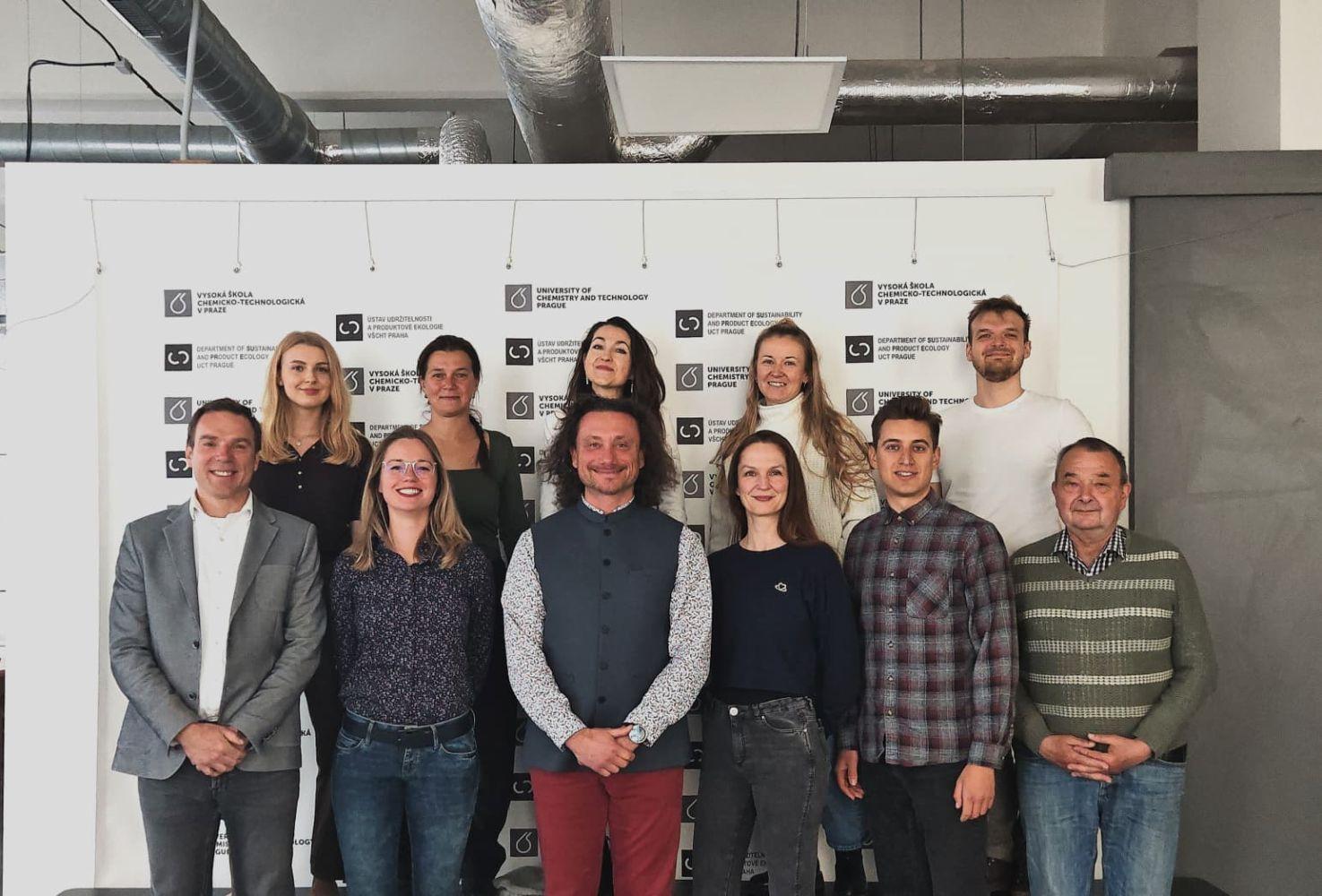
About department
SUPRE addresses what truly drives the performance of modern production. It focuses on technology, materials, and energy as the core elements of industrial systems, managing them in a way that allows their impacts to be not only described but, above all, compared and utilized for decision-making.
We evaluate technological solutions and products based on their material, energy, and emission characteristics. We convert technical data into an understandable format that enables choosing between alternatives—whether for technology design, production process modifications, or corporate strategic decisions.
Our work is based on a full life-cycle perspective. We monitor systems from raw materials through production to the final product, its use, emissions, and other outputs. We work with material and energy flows, the carbon footprint of products and organizations, and the assessment of substances that may pose environmental or health risks.
SUPRE connects technical expertise with analytical tools and systematic alternative comparison. The goal is not to create isolated studies, but to answer a practical question: which solution makes sense in a given context, and why.
A significant part of our activity involves sustainability management, understood as working with data from real-world technological processes. The results of our analyses are used in corporate management, investment planning, and decision-making regarding changes in industrial systems.
We are also dedicated to industrial and environmental design. We view design as a technical engineering process that connects function, feasibility, material and energy intensity, as well as product behavior throughout its life cycle.
An important component of our work is the project management of technology-oriented projects, especially where analytical outputs need to be put into practice—during the implementation of new technologies, production optimization, or the preparation of strategic changes.
SUPRE operates across various industrial sectors. It creates a space where engineering, the environment, systems evaluation, and data-driven decision-making converge.
Topics of our Research
Research at SUPRE focuses on the operation of technological systems within a real-world industrial context. We monitor how technologies utilize materials and energy, what emissions they generate, and how their impacts are reflected throughout the entire life cycle. SUPRE addresses topics across multiple industrial sectors. The common denominator is the effort to understand technological systems as a whole and to create decision-making foundations based on data, not assumptions.
Technology, Energy, and Production Systems
We analyze production processes and technological solutions in terms of their material and energy intensity. We deal with energy production, industrial technologies, and innovative manufacturing processes, evaluating their impacts within a broader context.
Raw Materials and Material Flows
We investigate the use of primary and secondary raw materials in industry. We monitor their availability, processing, and reuse options. Emphasis is placed on critical raw materials, recycling, and the circular use of materials in various sectors.
Circular Economy and Waste
We focus on how to effectively utilize waste as a resource. We evaluate recycling technologies, waste material processing, and their reintroduction into production. We monitor the systemic impacts of circular solutions and their real-world functionality.
Water and Environmental Technologies
A major area of our focus is water management and treatment. We explore new approaches to water resource utilization, wastewater treatment, and the possibilities of decentralized solutions in various types of environments.
Materials and New Technologies
We dedicate our research to the development and evaluation of new materials and technological solutions, including advanced manufacturing methods. We monitor their properties, application possibilities, and the impacts associated with their production and use.
Life Cycle Assessment and Decision-Making
The fundamental tool of our work is Life Cycle Assessment (LCA) and other analytical approaches. These enable the comparison of alternative solutions and support data-driven decision-making—from technology design to strategic management.
Design and Solution Modeling
We study how to design products and technologies so that they make sense from the perspective of materials, energy, and environmental impacts. We view design as a technical process that connects conceptual proposals with their realization and performance in practice.
Methods and Approaches
In our research at SUPRE, we work with methods that allow us to analyze technological systems in their entirety. We focus on how materials and energy are utilized within these systems, where emissions are generated, and how individual decisions translate into impacts throughout the life cycle. The goal is not only to identify sources of environmental burden but, above all, to understand their root causes and propose solutions that make sense in a broader context.
The basic framework of our approaches consists of a combination of two modeling and assessment directions:
-
Bottom-up Approach (from detail to system): This approach is based on a detailed knowledge of materials, processes, and technologies. It allows for an accurate description of specific products and production systems and the analysis of their environmental profile. A typical tool is attributional LCA, which we use to quantify the impacts of individual alternatives, identify significant flows, and support technical design.
-
Top-down Approach (from system to detail): This direction works with aggregated data at the sector, economy, or organizational level. It captures broader systemic relationships, indirect impacts, and effects that are not apparent from a detailed analysis of individual processes. We primarily utilize Input-Output Analysis (IOA) and its environmentally extended variants.
Integrating Approaches and Advanced Methods
In practice, both approaches complement each other. Therefore, we develop and apply methods that connect them, enabling consistent system analysis across scales. This includes, in particular, consequential LCA, corporate (organizational) LCA, Material Flow Analysis (MFA), and hybrid approaches combining LCA with IOA or MFA. This area also includes the development of material circularity indicators to evaluate the actual functioning of circular systems.
Whole Life Cycle Assessment
The methods we use always operate within clearly defined system boundaries and with a view of the entire life cycle—from raw material extraction through manufacturing to the use phase and end-of-life product management. We place great emphasis on data consistency, transparency of assumptions, and the comparability of alternatives.
Economic and Social Aspects
In addition to environmental assessment, we expand our analyses to include economic and social dimensions. For economic evaluation, we mainly use LCCA (Life Cycle Costing), which allows for the assessment of costs throughout the entire life cycle. Social aspects are analyzed using S-LCA, focusing on impacts on working conditions, society, and broader socio-economic contexts.
Supporting Data-Driven Decision-Making
The outputs of our analyses serve as a foundation for both technical and strategic decisions. We do not use methods in isolation, but as part of a process that leads from data to a choice between alternatives. We emphasize the interpretation of results, uncertainty management, and the ability to translate complex analyses into an understandable format for practical application.
SUPRE thus combines detailed technical modeling with a systemic view of industrial and societal processes. It is precisely this combination that allows for the evaluation of technologies not just individually, but within the context of the entire system in which they operate.